

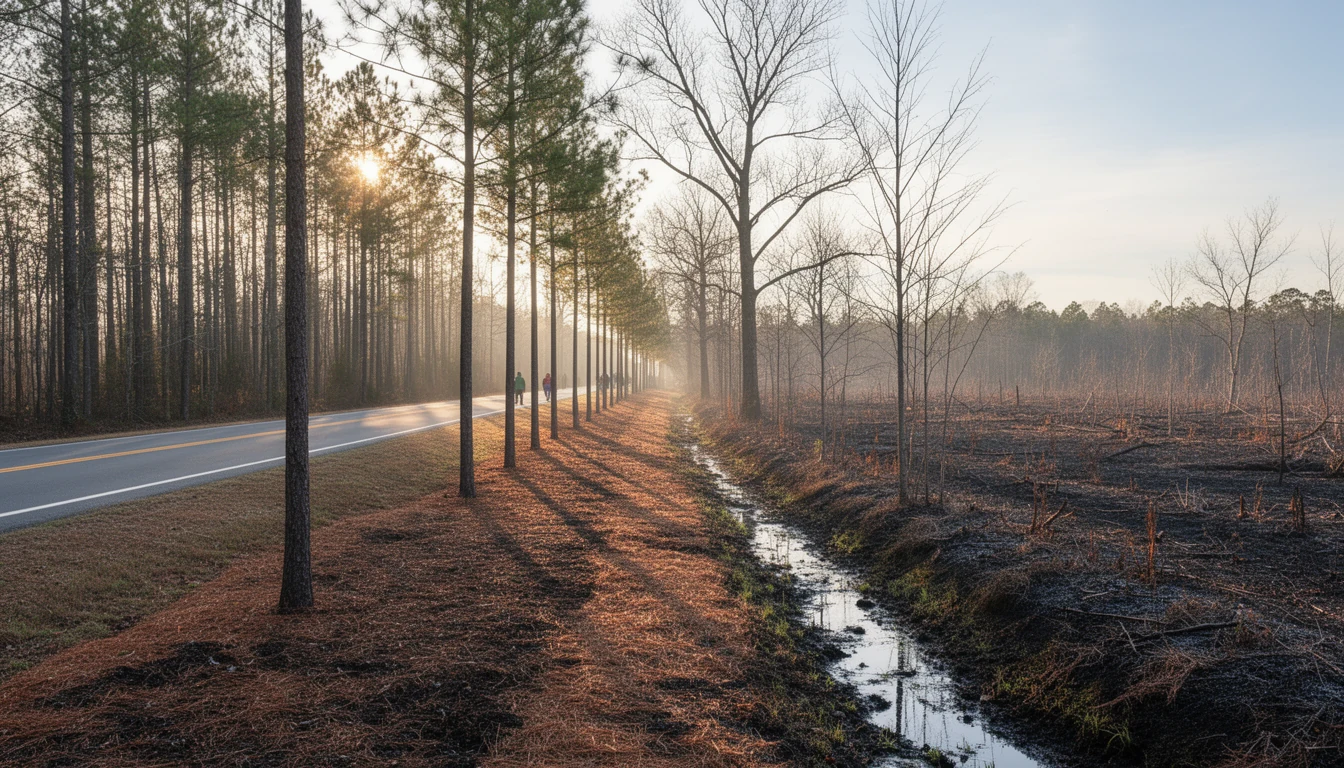
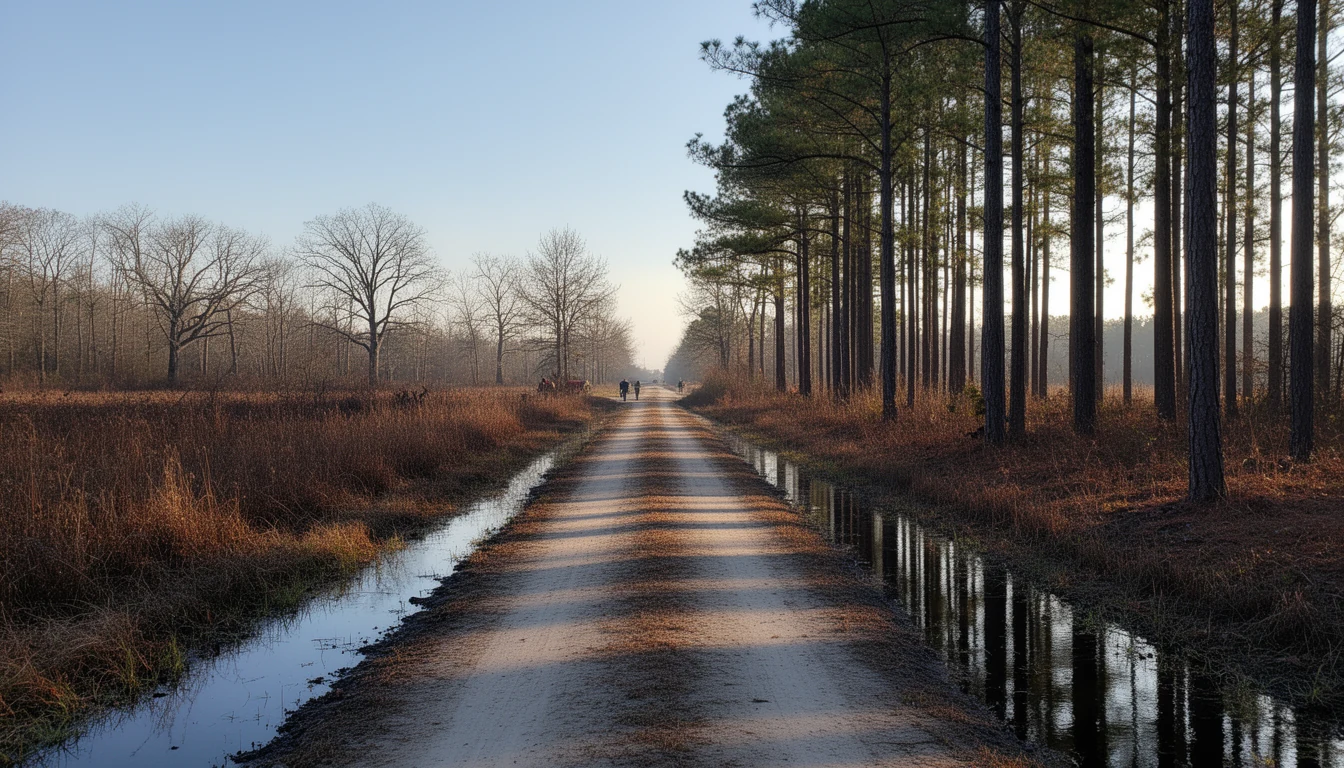
Standing on a fire break off NC 308 outside Aulander in late February, you smell the ground before you see what is on it: wet peat, pine duff, and diesel from the dozer that cut the line last fall. There is a loblolly stand on one side that needs thinning and a cutover on the other that needs planting, and the owner is holding an estimate for both. He assumes the bill is his.
Most of it is. But not all of it. Bertie County has two sets of pockets that will put money toward pieces of that work: federal programs run out of a service center, and state programs run through the district office on Dundee Street in Windsor. Seven of them are worth knowing, and every one of them has a catch worth knowing first.
One thing to get straight at the top, because it saves disappointment: this is cost share, not a grant. You do the work to a spec, you get reimbursed a percentage of a predetermined cost, and you wait your turn. Projects are scored and ranked, funds are limited, and a good project in a tight year can come up empty. Treat the list as a discount on work you already planned to do, not as a reason to do work you would not otherwise touch.
1. EQIP: the workhorse for timber and pasture
The Environmental Quality Incentives Program, run by the Natural Resources Conservation Service, pays for the practices most Bertie woodland owners actually need: forest stand improvement, fire and fuel breaks, prescribed burning, tree establishment, and habitat restoration. The N.C. Forest Service puts the reimbursement at up to 75 percent of the cost of qualifying practices, and the work has to follow a plan an NRCS agent approves in your conservation district.
Applications run continuously, but NRCS sets a cutoff each year to rank and fund them. The fiscal 2026 cutoff was Nov. 7, 2025. Missing it does not disqualify you; it moves you into the next ranking, which is a normal place to land.
2. CSP: paid to keep doing it right
The Conservation Stewardship Program pays a different way. It is a five-year contract with annual payments, split between maintaining the level of conservation you already have and adding new practices on top of it. NRCS sets a minimum annual payment of $4,000 so that small acreage can compete, and North Carolina ranks non-industrial private forest land in its own pool, separate from cropland.
This is the one for ground that is already in decent shape. If you have been managing a stand for twenty years and never took a check for it, CSP is the program that pays for the part you have been doing for free.
3. The state cost share that runs out of Windsor
The North Carolina Agriculture Cost Share Program is administered by the Bertie Soil and Water Conservation District, not by an agency in Raleigh, and it targets runoff of sediment, nutrients, animal waste, and pesticides. It reimburses up to 75 percent of the average cost of the practice, and there is a companion program, AGWRAP, for water storage and irrigation efficiency.
Because it is a district program, “can I get funded” is a local question. Districts get an allocation rather than an open checkbook, and applications are scored. A call to the Windsor office before you buy pipe or rent a dozer is worth more than a call after.
4. FDP: reforestation money, with a plan attached
The Forest Development Program, run by the N.C. Forest Service since 1977, is the main cost-share route for putting trees back in the ground: site preparation, seedlings, planting, and release from competing vegetation. It reimburses a share of actual cost or the prevailing rate, whichever is less, and the rate goes up for longleaf pine, hardwoods, and wetland species. A landowner can generally receive cost share on up to 100 acres in a year.
Two conditions shape how you use it. You need a forest management plan approved by the Forest Service first, which is worth having on a working tract anyway, and you work through the county ranger rather than a portal. The second is money. FDP has historically been funded largely by assessments on the forest products industry rather than the general fund, which is why the prevailing rates reset each fiscal year and why the acreage cap exists.
5. CRP: rent for ground you are not farming
The Conservation Reserve Program, run by the Farm Service Agency, pays annual rent on environmentally sensitive land plus cost-share help to establish the cover. Contracts run 10 to 15 years, longer when trees are the practice.
The catch is the calendar. CRP enrollment comes in windows rather than continuous signup: the fiscal 2026 General CRP window closed April 17, 2026, Continuous CRP closed May 1, 2026, and Grassland CRP ran May 4 through May 29, 2026. If you are interested, ask the Windsor service center when the next window opens. And understand what you are signing, because CRP takes that ground out of production for the life of the contract.
6. ACEP: easements, both kinds
The Agricultural Conservation Easement Program has two halves. Agricultural land easements protect working farms and ranches and are generally held by an eligible entity such as a land trust or the state rather than written directly to a landowner. Wetland reserve easements pay to restore wetlands and then hold an easement on the result.
NRCS in North Carolina has historically restored around 1,000 acres of wetland a year through the wetland easement side, and much of that acreage has been pocosin land, the deep peat ground that shows up across eastern North Carolina and drains into the ditch system. If you own that kind of ground, this is the program built for it. Understand that the easement is permanent and runs with the deed.
7. The N.C. conservation tax credit: the one with a clock on it
This is the program to read this month rather than someday. The General Assembly reinstated the conservation tax credit for qualified donations made on or after Jan. 1, 2025, and it expires for donations made on or after Jan. 1, 2027. Do the arithmetic on the calendar: 2026 is the window.
The credit equals 25 percent of the fair market value of a qualified donation, claimed against state income tax. The donation has to be in perpetuity, and it has to go to the state, a local government, or a conservation body qualified to hold land. The qualifying uses are specific: forestland or farmland preservation, fish or wildlife conservation, historic landscape conservation, public trails, and floodplain protection in a county that had a Type II or Type III gubernatorial disaster declaration in the five years before the donation.
There are caps. Statewide, the credit is limited to $5 million a year, with $3.25 million prioritized for forest and farmland donations, and the law limits what any one taxpayer can be allocated.
The mechanics are where people lose the money. You have to get certification from the N.C. Department of Natural and Cultural Resources identifying the qualifying use, then file Form NC-74 with the Department of Revenue between Jan. 1 and April 15 of the year after the donation. For the 2025 donation year, the certification request had to reach NCDNCR by Feb. 15, 2026, so if a 2026 donation is on your mind, confirm that date early rather than late. The credit also cannot be taken in the year you donate; it lands on the return for the year the application becomes effective.
None of this is tax advice. Run it past your accountant and the receiving land trust before you commit an acre.
Where the paperwork actually starts
Three doors, all in Windsor:
- Bertie Soil and Water Conservation District, 106 Dundee St., Suite 211, (252) 794-5305. The front door for the state cost-share programs.
- The USDA service center at 106 Dundee St., (252) 794-5308, where NRCS and the Farm Service Agency sit. EQIP, CSP, CRP, and ACEP all start at that counter.
- The N.C. Forest Service county ranger, for the Forest Development Program and the management plan it requires.
Bring the deed, a survey if you have one, last year’s tax bill, and any existing management plan. The first meeting is cheap. The mistake it prevents is not.
What this is not
Four limits, because the programs are real and so are the reasons they do not always deliver:
- It is reimbursement, not upfront money. You carry the cost until the practice is certified and the payment cycle runs.
- Appropriations lag demand. The state’s own cost-share reporting has said for years that requests run well ahead of what districts are allocated. A strong project can still wait.
- Easements are permanent, and they show up at resale. A conservation easement limits what the next owner can do and what some buyers will pay. If you might sell in a few years, the easement programs are the wrong tool.
- The money follows practices, not intentions. No program pays you simply to leave ground alone; you get paid to install and maintain specific things.
The part that matters at a closing
If you are buying in Bertie County rather than owning here already, this list changes the math on a tract. A parcel with a management plan, a stand that has been thinned, and a perc-tested building site is worth more than one you have to bring up from nothing, and cost-share eligibility is part of the reason. The Timber & Farmland Value chapter walks the working-land side of that, and the rural acreage due diligence chapter covers the checks to run before you write an offer.
If you own acreage in Bertie County and you are trying to figure out which of these fits the ground in front of you, that is a conversation worth having before you spend your own money. Travis has spent his working life in this county’s dirt, timber, and farmland, and he can tell you which program a specific tract is likely to score for and which one is not worth the application. Reach out when you are ready to put a number against it.