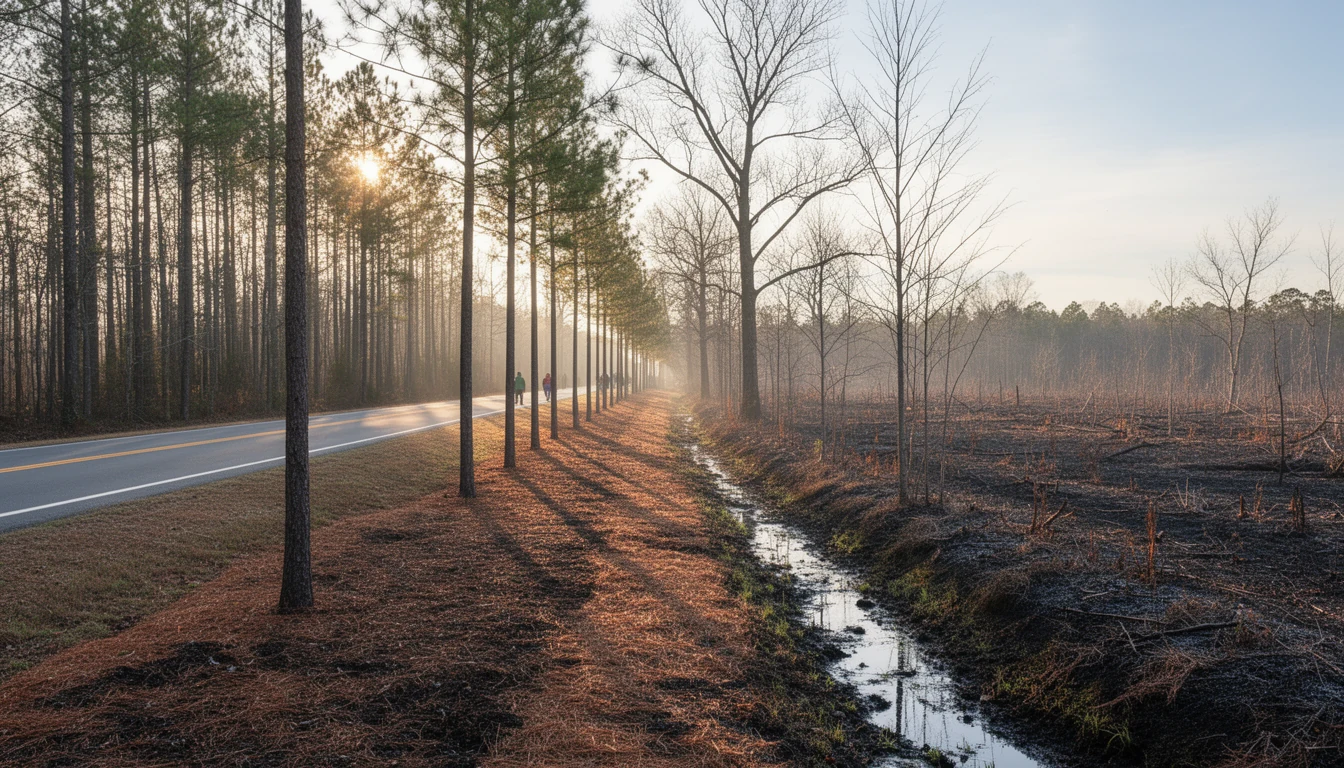


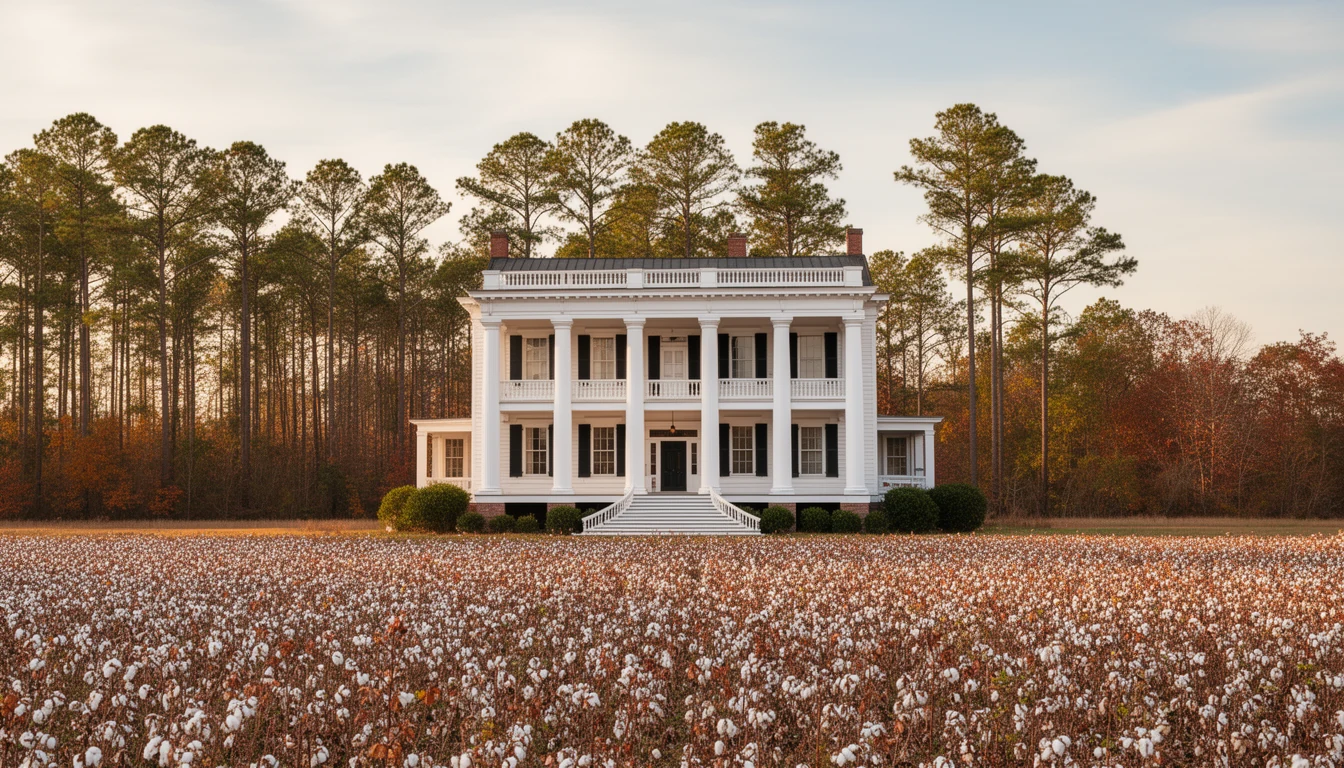
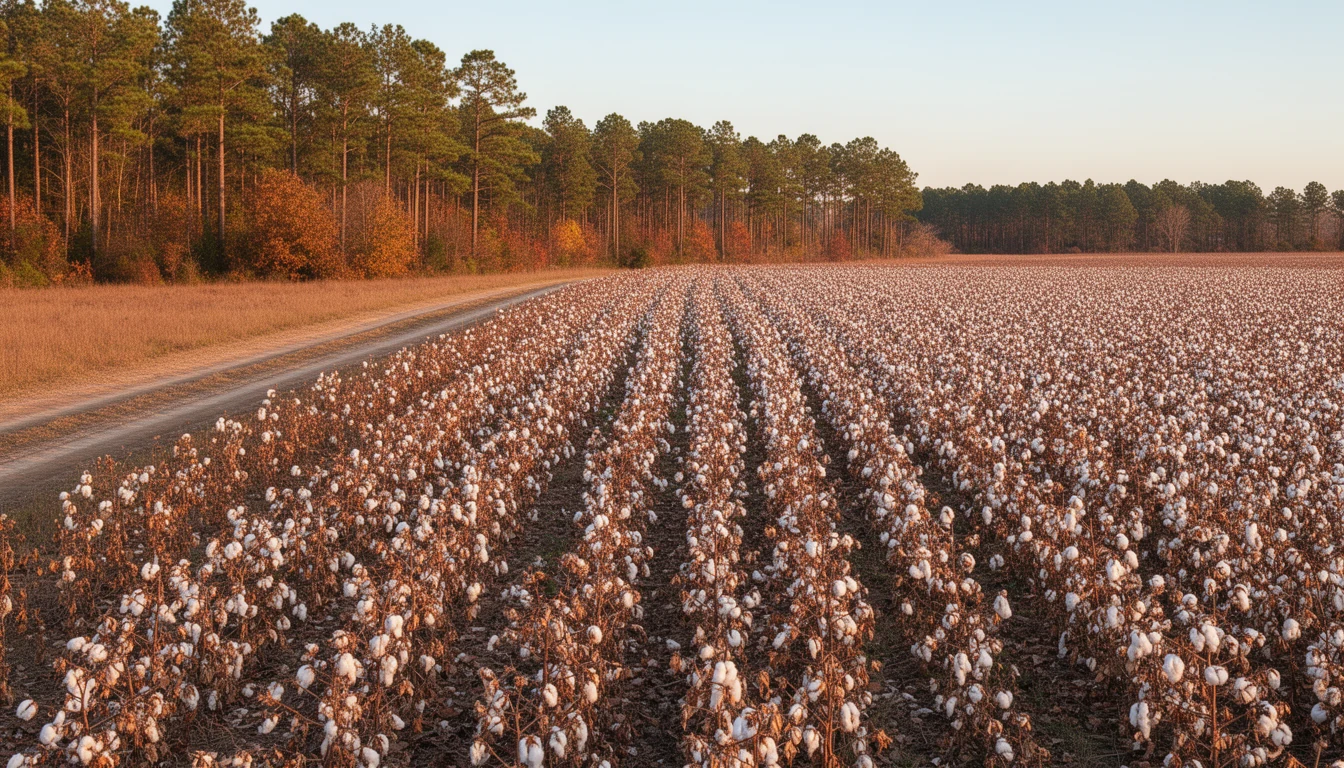
It is four miles out of Windsor on NC 308, and in October the fields on both sides of the road are doing the two things Bertie County does in fall. The cotton is opening white in the bolls. The peanuts are still in the windrows, curing, and the smell of them rides over the road the way it does all over this county this time of year.
Then the road bends, and the house is there on its brick piers, white against the pines, with a widow’s walk on the roof and that odd, intricate railing on the portico catching the low light.
That is Hope Plantation. It was built in 1803, and it is why people who have never set foot in this county still know the name.
A house built the way the book said
Hope is a Palladian house in the Federal style, and it is one of the finest examples of that design ever built in timber. Stone did not improvise it. The plan follows a plate in Abraham Swan’s The British Architect, a book that was in his library, almost line for line.
The facade has five bays and a pedimented double portico, with the original Chinese Chippendale balustrade on both stories and again on the roof walk. The house sits on high brick piers, so there is a full storey of basement still above ground. Four stepped chimneys and eight windows to a side hold the symmetry. Walk around to the back and there is a single-height portico, the same Chippendale motif repeated. The kitchen has been rebuilt on its original foundation, and the dairy has been restored.
All of it went onto the National Register of Historic Places in 1970.
The governor who built it
David Stone was born in Bertie County in 1770, the only son of Zedekiah Stone and Elizabeth Hobson. He graduated first in his class from the College of New Jersey, now Princeton, in 1788, then read law under William R. Davie at Halifax.
From there the record gets long. Stone represented Bertie County in the House of Commons from 1790 to 1795. He sat as a superior court judge. He went to the U.S. House in 1799, and to the U.S. Senate in 1801. On Nov. 28, 1808, the legislature elected him governor, and he served two terms, into December 1810. The State Bank of North Carolina was chartered during his second term. He returned to the Senate in 1812 and was censured by the General Assembly for opposing the War of 1812, a position he would not abandon. He resigned in 1814 and came home.
He died in 1818 at Restdale, his other plantation near Raleigh. Hope was the Bertie County seat of the family’s fortune.
The name on the land
The land under the house was granted to the Hobson family in the 1720s by the Lords Proprietors, who were still handing out Carolina acreage like it might run out. Francis Hobson and his wife Elizabeth came from Hope Parish in Derbyshire, England, to live on it. After Francis died, Elizabeth inherited the property, and when she married Zedekiah Stone, the land became his. He named it Hope, for her parish.
Their son David was given the tract in 1793, the same year he married Hannah Turner. Eleven children were born to them, and six reached adulthood.
The work behind the house
A house like this did not get built on crops alone, and the honest version of the story says so. Hope was a working plantation, and the labor that made it run was enslaved labor. The 1800 federal census counted 59 enslaved people held by David Stone in Bertie County. By the 1810 census, the last one taken in his lifetime, the number was 98. Archaeologists have worked the ground near the house to find the probable location of the quarters where those people lived, and the Foundation tells that part of the history, not just the architecture.
The county that would not let it fall
By the 1960s the mansion had come through nearly a century of neglect. People in Bertie County, with help from across the state, formed the Historic Hope Foundation, a nonprofit, to buy the house and save it. It was restored and opened to the public in 1972, and the Foundation has run it since.
Today the Foundation holds 45 acres of what was once a tract of well over a thousand acres. Standing on the grounds beside the mansion is the King-Bazemore House, built in 1763 and moved about four miles to this spot. It is a hall-and-parlor house, one of only two in North Carolina with a gambrel roof and brick end walls, and it is furnished from the 1778 inventory of its owner, William King.
If you go
Guided tours cover the mansion, the King-Bazemore House, and the gardens. The Heritage Center Museum and the grounds themselves are free. The Foundation is running a capital campaign called Hope for Tomorrow to pay for repairs on both houses, which is the honest reason to call ahead: hours have shifted seasonally, and a reservation is the safe way to plan a trip. The number on the site’s own materials is 252-794-3140. It is four miles out of Windsor, off NC 308.
What it means if you are buying here
Bertie County is a county of roughly 17,000 people, and it has been getting smaller for years. A landmark like Hope is a real asset in a place that size. It pulls the Historic Albemarle Tour through the area, it sits a short drive from Windsor’s downtown and its 1889 courthouse on King and Dundee streets, and it gives the county a story to tell that most rural counties cannot.
It is also a fair picture of the arithmetic here. The house was built on an agrarian economy that was enormous a century ago and is thin now. It survives on a nonprofit and donations, not ticket sales. The county is chasing grant money for a pocket park and a water line because the tax base will not cover everything it inherited. None of that is a reason to stay away. It is the reason prices are what they are, and the reason a buyer here should care who is keeping the lights on at the places that matter.
The portico is still standing on its brick piers, four miles out of town, white against the pines, and it stands because people here decided once that a landmark was worth paying for. If you want to walk this ground with someone who knows the county, reach out to Travis and the team at Horizon Real Estate Group.